The Foundry
A workshop for writing a whole book.
Elsewhere, a book goes through six pieces of software before it exists. Here, none.
Your characters, your places, your threads: open beside the text.
Chapters
644 065
words in the book
The Ninth Bell
The Salt Court had changed since the last tide — a letter with the seal already broken lay half-buried near the steps, and no one moved to clear it.
Sael Marrow stood at Low Solmere, watching gulls wheeling low, unwilling to land.
Everything in one place
Write, correct, lay out, make the visuals, sell — without ever opening a second tool.
Web-native
It opens in the browser. Nothing to install, nothing to sync, on every one of your devices.
Built for fiction
Chapters, scenes, statuses, a story bible and writing tools — not a blank document.
Built to grow
Tested well past 600,000 words without a hint of slowdown — write the whole saga in one place, not just one novel.
01 · The difference
Write “Nils”. His card opens itself.
You never pin a note, never search, never leave the page. The workshop reads what you write and puts the right cards beside it. Try it: click into the text below and write “Nils”, or “the copper key” — then delete a name and watch its card go.
Chapter 4 · scene 2
The shutter
Runs the bakery. Never sits down.
Already written
Chapter 2 · “Wren had the kind of hands that never fully came clean.”
Six shopfronts. One of them always empty.
Already written
Chapter 1 · “Ferry Street smelled of rain and warm sugar.”
02 · What it replaces
Elsewhere, your book changes software six times.
Here, all six steps are in the same workshop.
Elsewhere — six subscriptions, six exports
Here
The Foundry
One account, one address.
- The workshop, the binder, and the Codex that fills itself while you write
- A spellchecker that knows the names in your Codex
- EPUB, designed PDF, submission format
- The Poster tab: a sentence from your book becomes an image
- Your author page, your links, your QR code
- Direct selling, paid into your own account — 0% commission
And nothing is held here: everything exports, whenever you want.
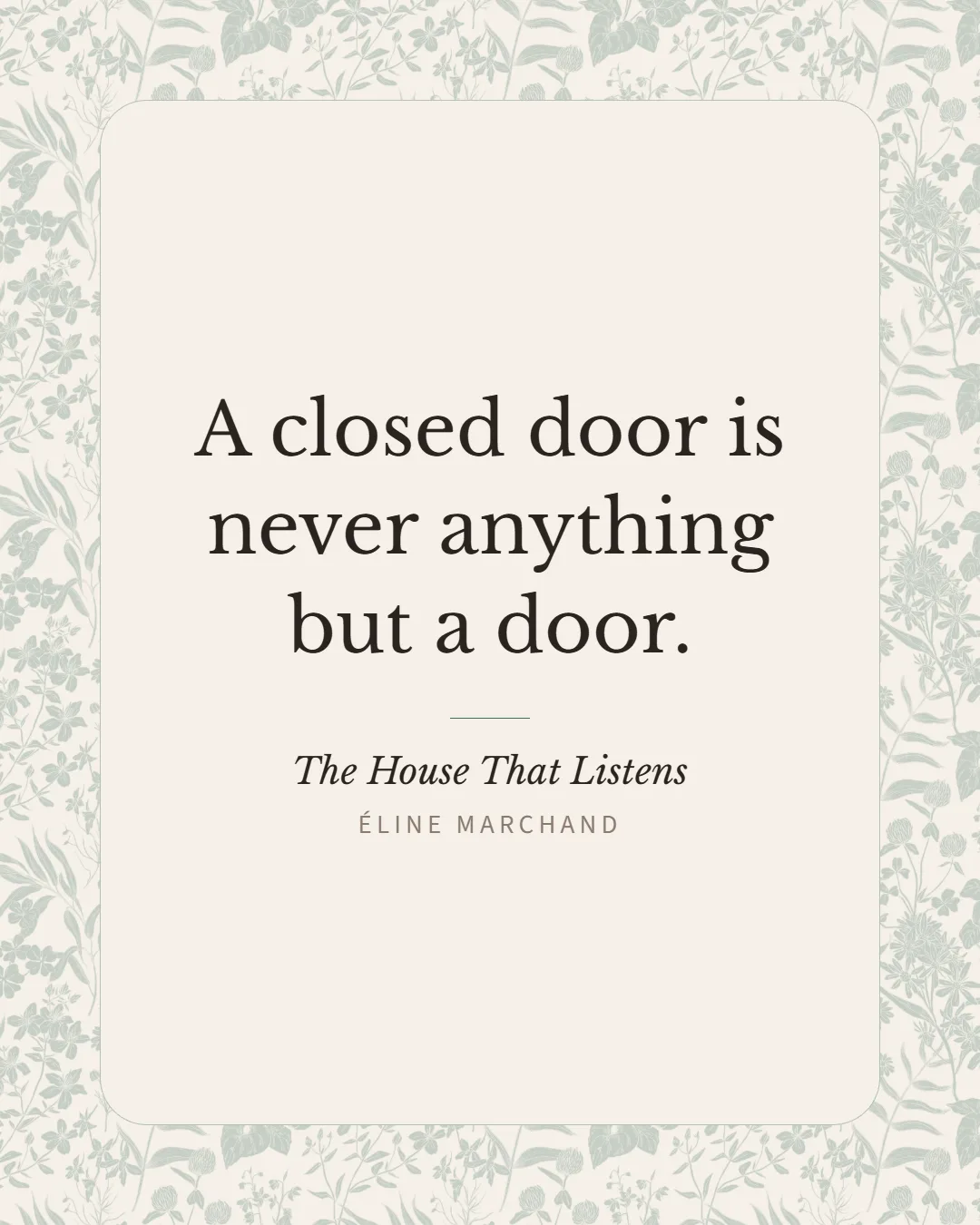
Step 4 · The poster tab
The image is already written: it is a line of your book.
Pick a sentence in your chapter. It becomes an image, ready to post — no design software, and nothing to learn.
Chapter eleven · scene 2
The back door
He put his hand on the doorframe, where the wood still kept the marks of childhood heights. A closed door is never anything but a door. That is what she used to say, in winter, when the wind forced the latch and none of them went to look.
Poster
03 · Writing
The rest of the book stays within reach.
A chapter reads as one continuous text, and any other scene can sit open beside the one you’re writing. Both are live below — type in them.
Two scenes, no seam — the down arrow crosses over.
1 · The shutter
2 · What the bell knew
Move a scene, the book follows.
The binder holds your book as a list, as cards, or as a sortable table. Cards move by hand — scene by scene, and from one chapter to another.
The ninth bell
1 240 words
Low Solmere
860 words
The tide-worn ledger
1 512 words
What the Marshal knew
704 words
Grab a card by its handle and drop it on another.
And a note, right where you left it.
Sticky Notes float above the whole workshop — eight colours, moved and resized as you like. They stay open across tabs, and a co-author can answer in them.
Click one to bring it to the front. Move, write, drag the corner — the dot changes the colour.
No Save button. Not one, anywhere.
04 · Momentum
It counts, so you don’t have to.
Write below: the counters follow.
Chapter 6 · scene 2
What the tide brings back
Writing days
11
Day streak
1 240
Words / day (7d)
3 902
Best day
14 March
Projected finish
05 · Always with you
Your book,
in your pocket.
Nobody writes a novel with their thumbs. But rereading a scene, fixing a name, noting an idea: your book opens on the phone, same account, nothing to install.
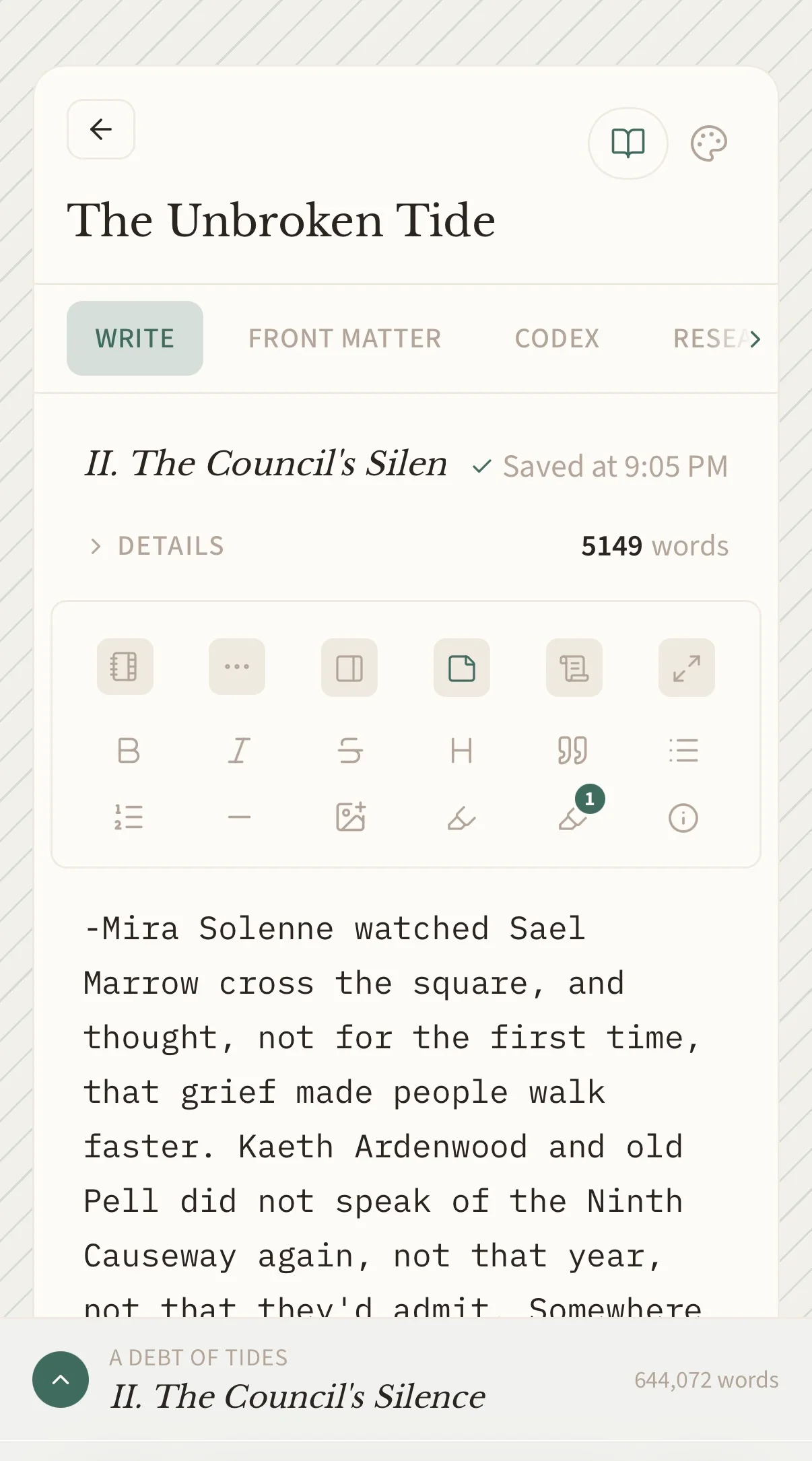
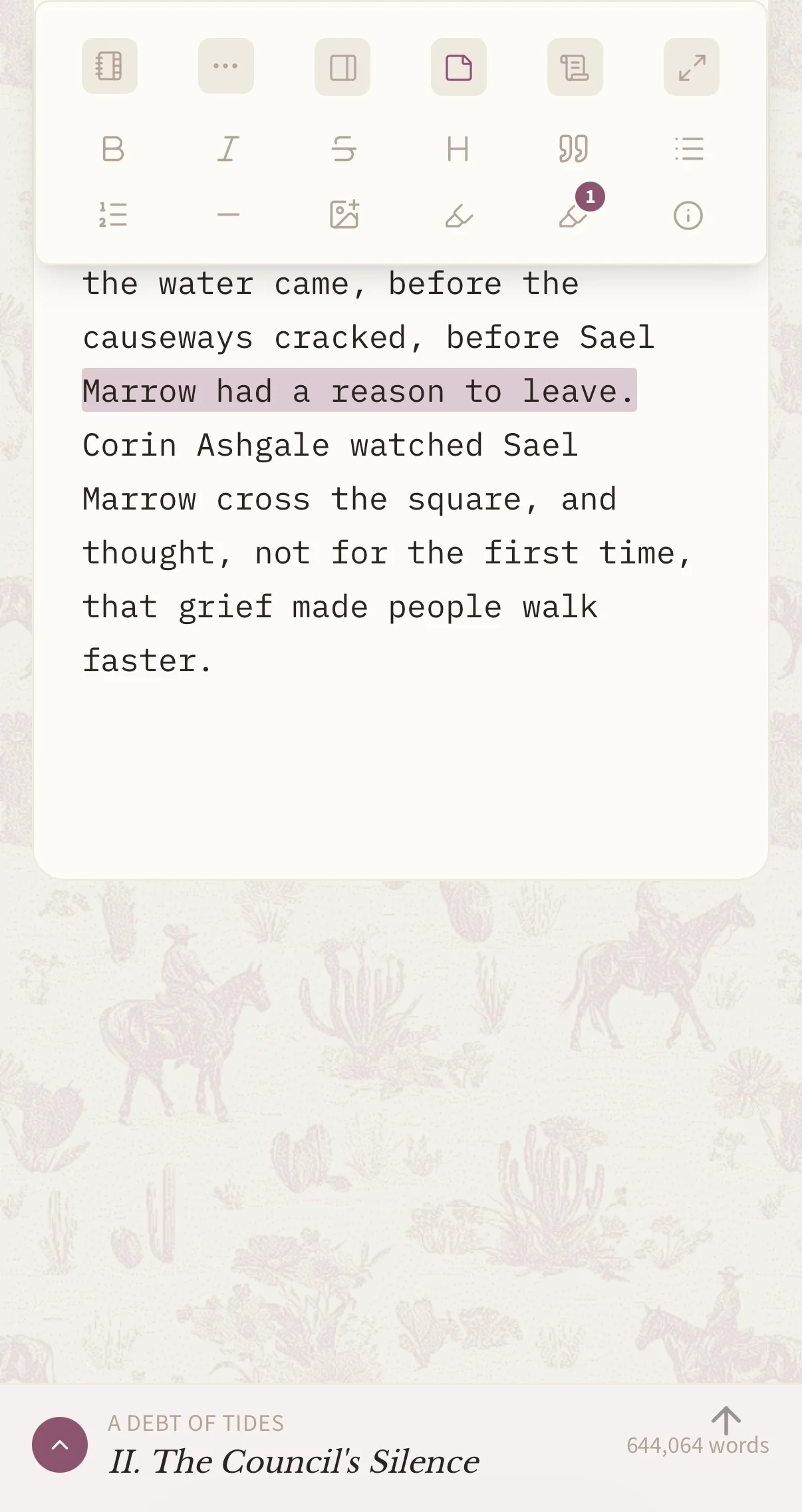
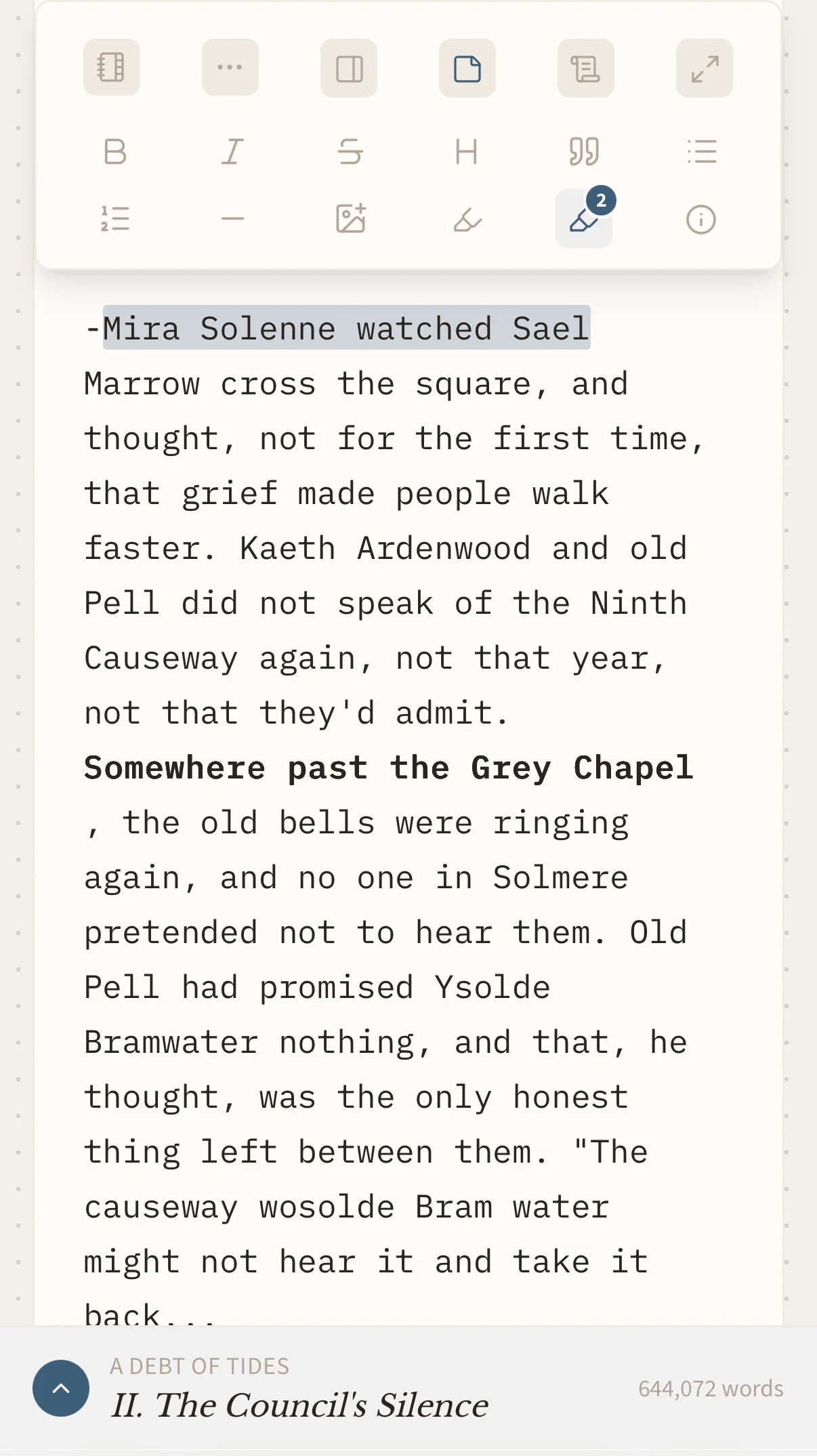
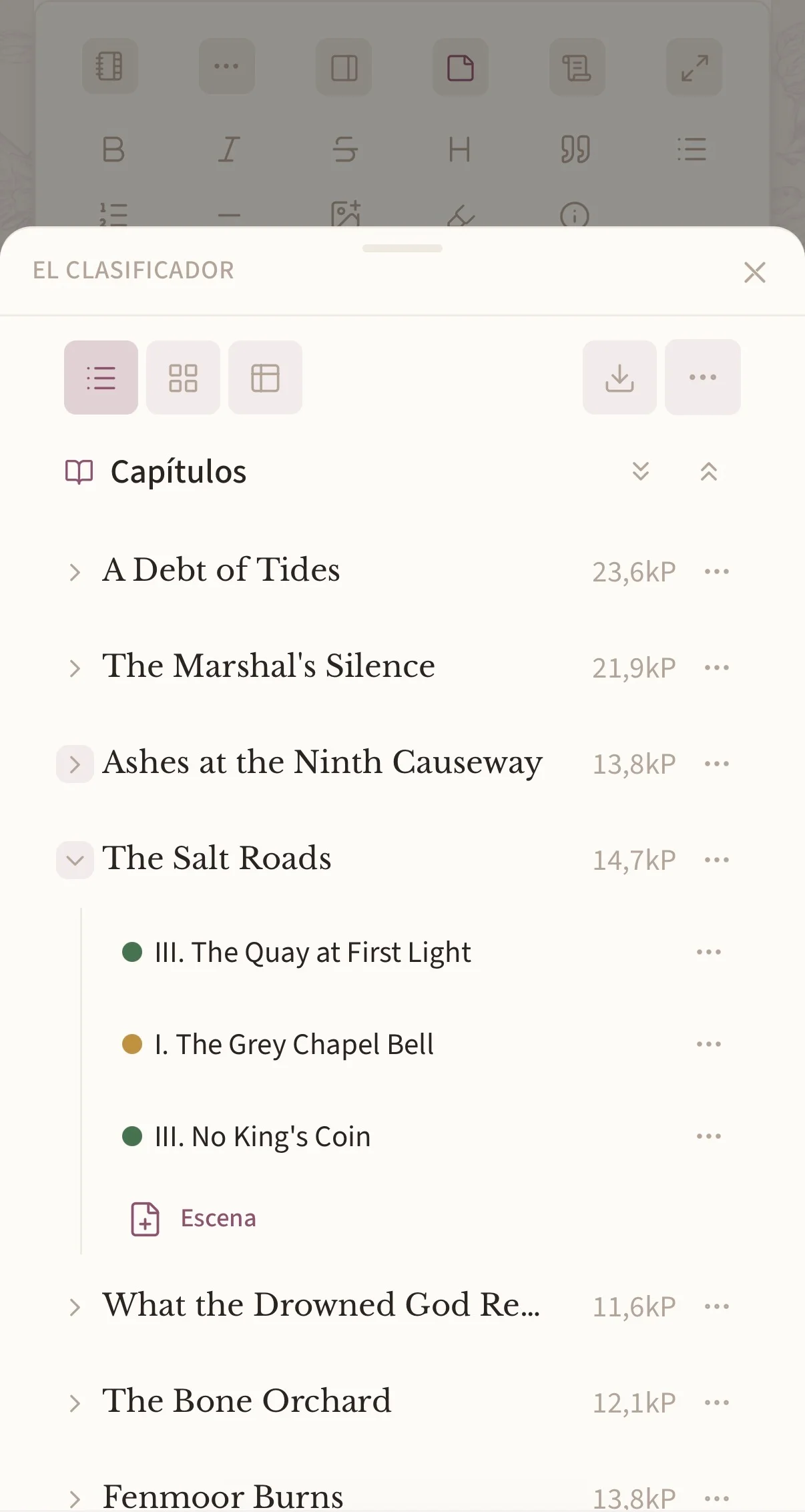
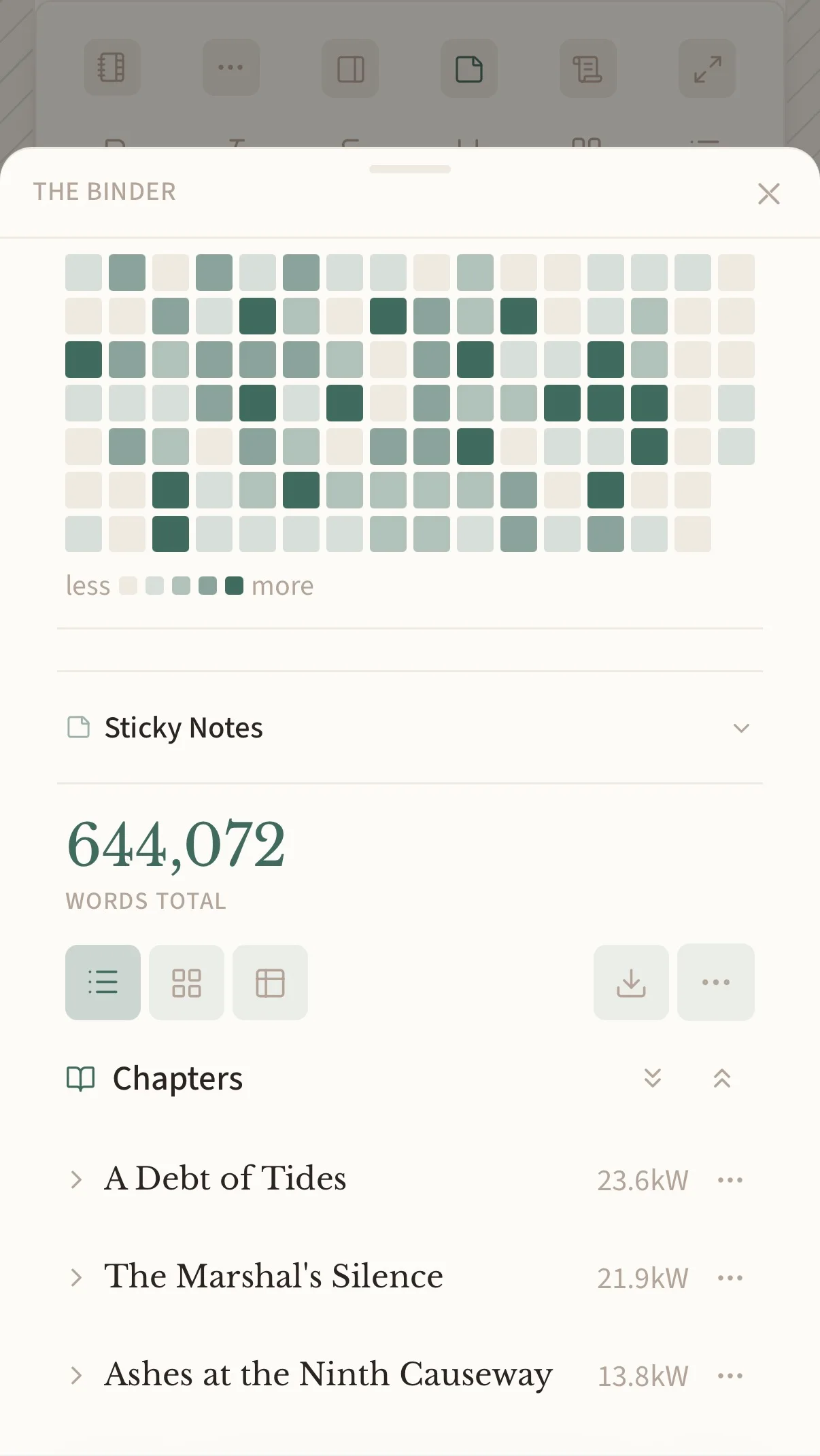
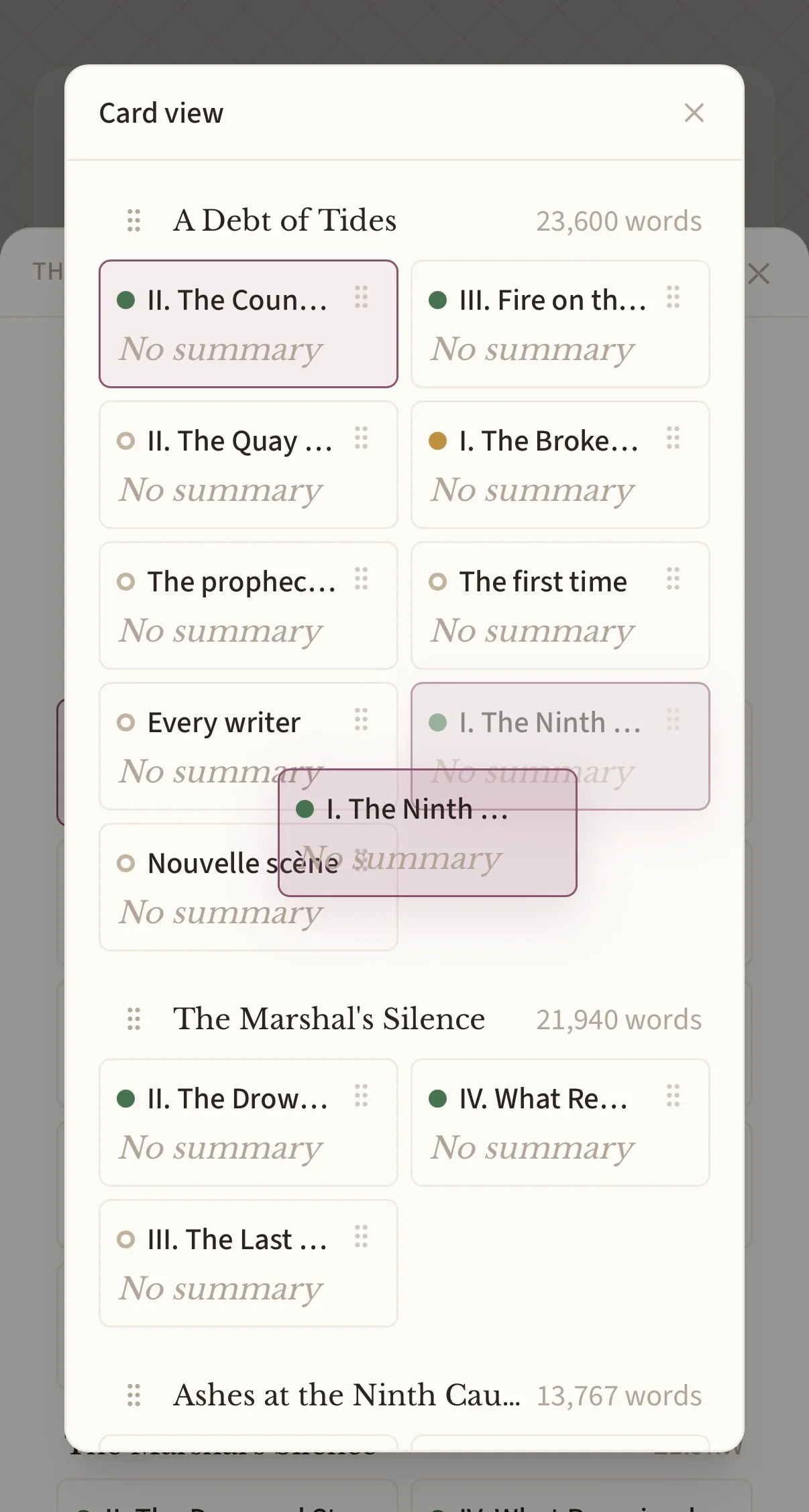
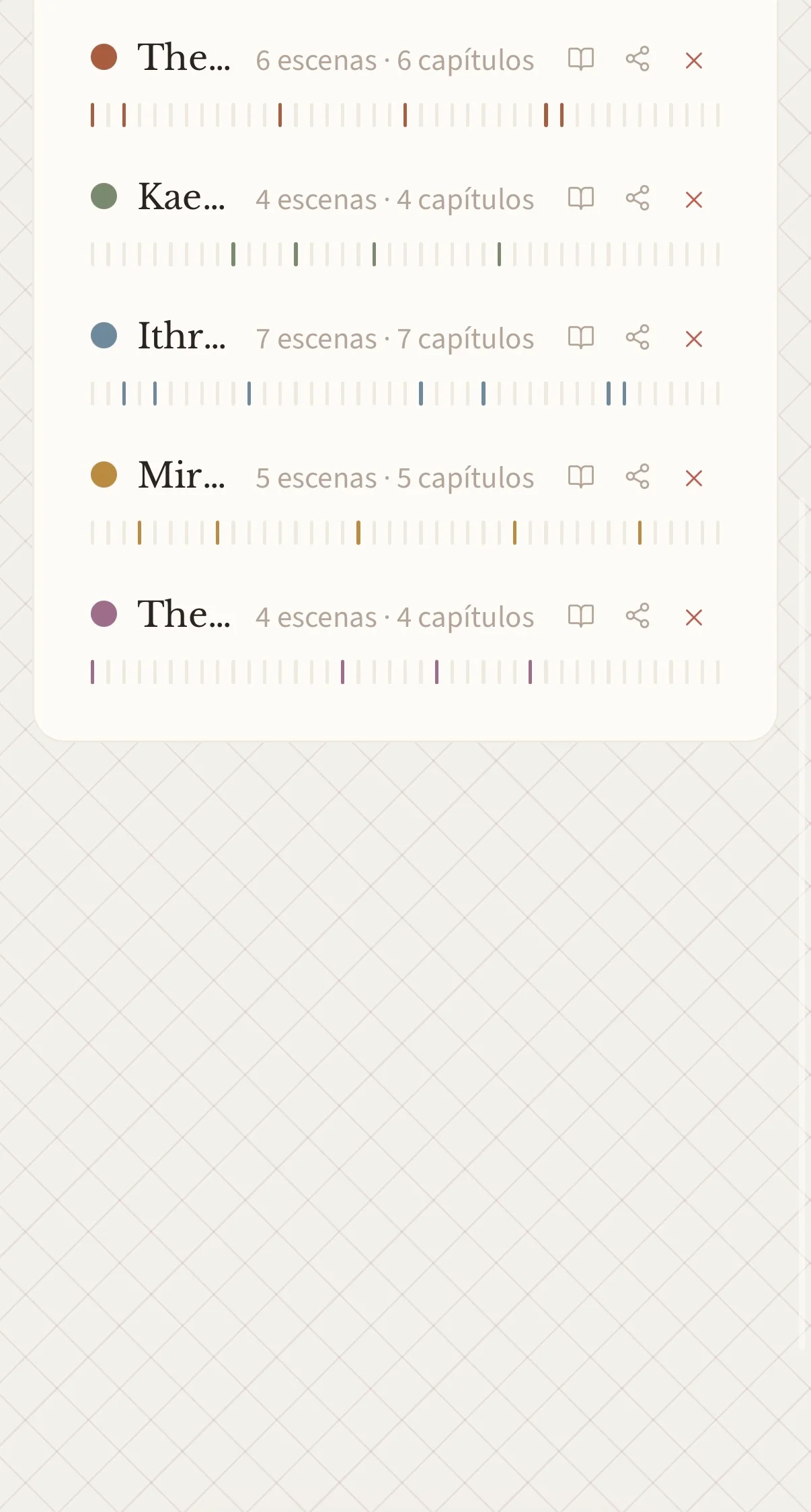
Characters, places, threads: in the tab next door.
06 · The Codex
One tab, instead of three subscriptions.
Characters and places. What ties them together. The subplots, and a grid to plot them on. It lives with the manuscript — and it’s shared across every volume of a series.
Cards AND labels move — grab one.
Entries, threads, and the whole plan.
The same three views as in the workshop, exactly as they look there — entry cards, threads across the chapters, and the grid where you plan a scene before writing it.
One square = one chapter of the book, in order. Coloured where the thread runs.
07 · Yours
Two writers, same tool, two different rooms.
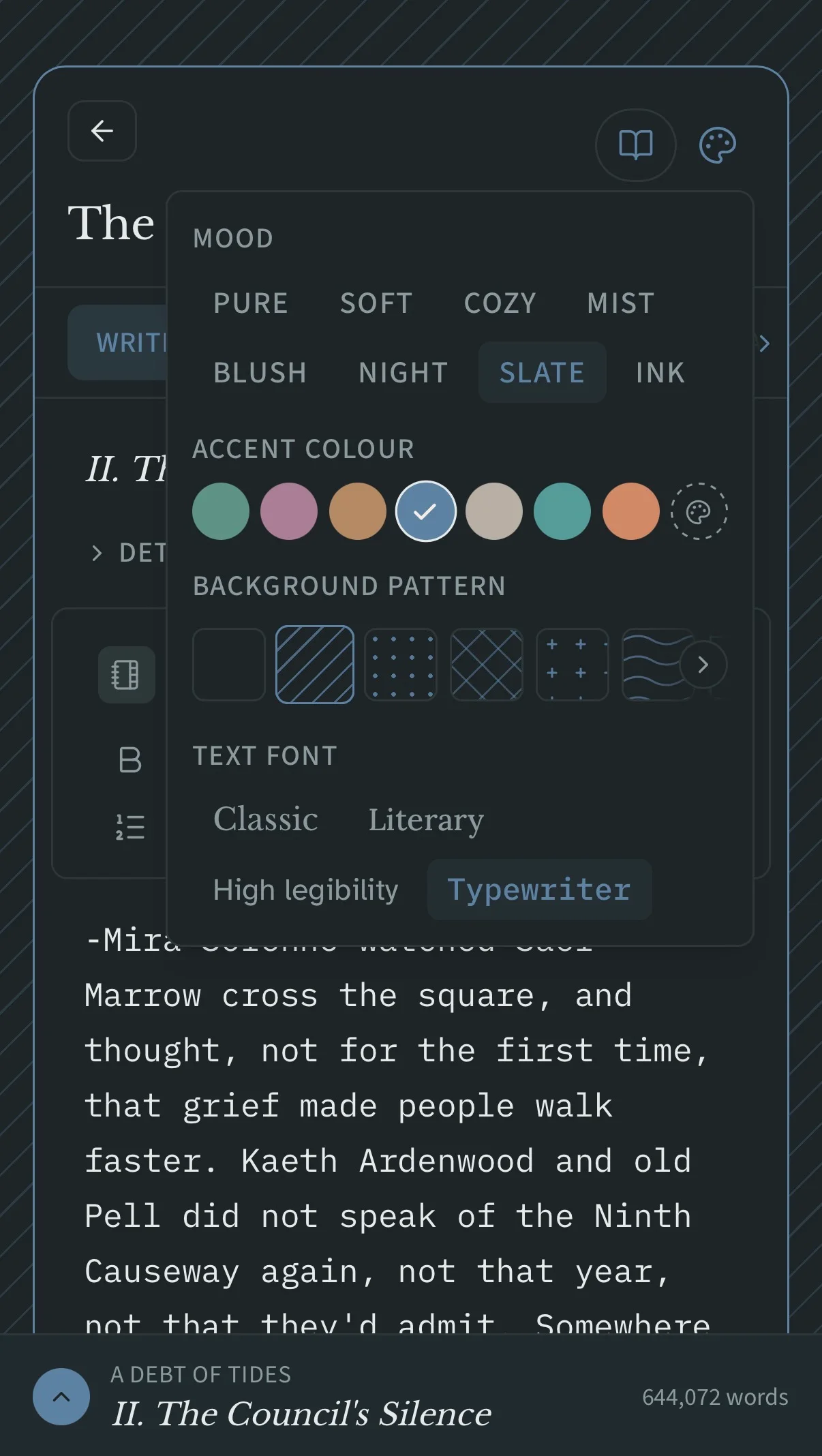
Nine papers, seven accents, patterns — florals, a western, crosses, dots — and it recolours the whole workshop, not one card. Try it here:
Mood
Accent colour
Background pattern
Text font
The shutter
Wren pulled the shutter down before the light had properly gone. Ferry Street held its breath — six windows, one of them dark for the third winter running.
#ShowMeYourFoundry
What the dark keeps
Nox unfurled a torn wing with a crack like contained thunder, and something turned over in her chest.
The bakery at six
The oven had been warm since four, and the street outside had not yet decided to be awake.
08 · Yours to keep
Nothing you write can be taken from you.
It saves itself, even offline
No save button, ever. Lose the network mid-sentence and you keep writing — a book you’ve opened once even reopens without a connection.
A version you name is kept forever
The end of the first draft, the version before the big cut. Name it and it never expires — and you can compare it word by word with today’s.
You can walk out with everything
EPUB, PDF, submission format, plain text — and a full JSON backup with your images inside it, readable even if this account disappeared tomorrow.
No AI is trained on your manuscript
Not now, not quietly later. It’s written into the terms, and it can’t change without asking you first, separately.
09 · Honestly
A workshop, not a cockpit.
If you have ever closed a writing app because it wanted to be configured before it would let you write a sentence :
What you won’t find elsewhere
- A reference panel that fills itself as you write
- “Already written” — the exact sentence, from chapter two
- One story bible shared across a whole series
- A co-author in the same book, live
- Publishing and selling, built in and optional
What we deliberately don’t do
- Screenplay mode
- A compile screen with forty options
- A desktop app that syncs through a shared folder
- An assistant that writes in your place
10 · When it’s finished
Your own page. Your price. Paid to you.
A finished book sells from your own author page, and the money lands in your account.
Start
Create your account. Try everything.
It’s free. No card asked for, nothing to install.
Open the workshopEverything, line by line
Every feature, and what it gives you.
The long version, for the ones who read everything before deciding. Every line below is already in the workshop, today.
Writing
Checking your text
The binder
The reference panel
The Codex
Your book as an object
Research and inspiration
Momentum
A room of your own
Writing together
Importing and exporting
Being seen
Publishing — if you want to
Trust
You’ve read it all.
Create your account